Tracking the weekend’s biggest games

The week’s two primetime marquee matchups lived up to their billing – both 5 Notre Dame vs. 2 Ohio State and 7 Utah vs. Florida as competitive as college football fans would have hoped, and far more competitive than those four fanbases were wishing them to be.

The Utah/Florida contest is a case where both teams are showing why there is optimism that brighter days are immediately ahead for both programs. Two crucial goal-line stands – one at the beginning of the third quarter, the other to end the game – were the biggest plays of the game. Utah had six plays to score within the five-yard line… and scored zero. An absolute heartbreaking way to being their season, and an absolute jolt of life given to Florida under new head coach Billy Napier.

In Columbus, Ohio, the Fighting Irish gave the high-powered Buckeyes offense an admirable fight, holding the unit under 200 yards midway through the third quarter. But their lack of depth showed up in a big way in the second half, as they were unable to capitalize on their 10-7 lead, eventually seeing Ohio State take the lead and never looking back.

I’ll be providing some deeper numbers into the quality and competitiveness of some of the most notable contests throughout the week. Below you’ll find a list of game drives for these two matchups, with the number next to them being how many points they’ve been up or down when they gained possession. Not only does this show what team had the lead more often, it will also help show the key moments where teams were able to flip the deficit or finding themselves unable to add to their lead. In essence, if both teams are in the negative, that means a more competitive match, as the two teams are down when they possess the ball. So, for example, while Ohio State’s 21-10 win looks pretty uneventful on paper, a detailed account shows that it was a much more competitive game, with the Buckeyes averaging being down half a point when their possessions began.

7 Utah (0.1) vs. Florida (-2.7)

1. Florida: +0 (0-0)1. Utah: +0 (0-0) TD
2. Florida: -72. Utah: +7
3. Florida: -7 TD3. Utah: +0 FG
4. Florida: -34. Utah: +3 FG
5. Florida: -6 TD5. Utah: -1
6. Florida: +1 [HALF]6. Utah: -1 DOWNS
7. Florida: +17. Utah: -1 TD/2 PT FAIL
8. Florida: -5 TD W/ 2 PT8. Utah: -3 TD
9. Florida: -4 TD9. Utah: -3 INT
10. Florida: +3 [END]Average: 0.1
Average: -2.7
First Half: -3.7 | Second Half: -1.3 (+2.4) … First Half: 1.8 | Second Half: -2 (-3.8)

5 Notre Dame (-0.8) vs. 2 Ohio State (-0.5)

1. Notre Dame: +0 FG1. Ohio State: -3
2. Notre Dame: +32. Ohio State: -3 TD
3. Notre Dame: -43. Ohio State: +4
4. Notre Dame: -4 TD4. Ohio State: -3
5. Notre Dame: +35. Ohio State: -3
6. Notre Dame: +36. Ohio State: -3 [HALF]
7. Ohio State: -3 [FIRST POSSESSION]
7. Notre Dame: +38. Ohio State: -3
8. Notre Dame: +39. Ohio State: -3 TD
9. Notre Dame: -410. Ohio State: +4 TD
10. Notre Dame: -1111. Ohio State: +11 [END]
First Half: 0.2 | Second Half: -2.3 (-2.5) … First Half: -1.8 | Second Half: 1.2 (+3.0)

This analysis also helps determine when each team was at its strongest. For example, Notre Dame’s execution in the first half resulted in Ohio State being down an average of 1.8 points at the beginning of each drive, while they had an average lead of just 0.2 when they possessed the ball in the first half. The second half was a different story, with Notre Dame on average being down 2.3 points when their possession began, and Ohio State being up 1.2 points at the start of their possessions.

In the Utah and Florida game, a similar story took place in that the two halves saw the two opponents in drastically different situations than they found themselves in previously. Utah had the edge for the majority of the first half, possessing the ball with leads of seven and three points on two occasions, only mustering a field goal when they had a three-point lead. Despite this, the Utes started their drives being up an average of 1.8 points, while Florida began their drives trailing by an average of 3.7 points. In the second half, Utah never began a possession with the lead, trailing by an average of two points. Florida, meanwhile, had leads to begin and end the half, and were able to successfully respond when down five and four points on back-to-back series.
Previewing the 2022 College Football Season

The college football season revs into gear this weekend with several marquee matchups and the college football elite in action. Here is a look at some of week’s most crucial matchups, and what they mean for each team should they win. At the end, check out my picks for conference champions, the CFP final four, and who will ultimately be crowned national champions.

11 Oregon @ 3 Georgia (Atlanta)

IF OREGON WINS The season is off to a chaotic start. Oregon finished a distant second to Utah in the Pac-12 a season ago, twice losing in decisive fashion to the Utes. Georgia, meanwhile, rode a dominant regular season into a brick wall in their conference championship game as well. But unlike Oregon, Georgia was able to avenge their loss, defeating Alabama in the national championship game. So while a win for Oregon might tell us more about the state of UGA football post-national championship, a win would undoubtedly vault Oregon into the upper echelon of the AP and Coaches Poll.

IF GEORGIA WINS As coach Denny Green once said, “they are who we thought they were.” While following up a national championship is always a tough act, a de facto home contest in Atlanta to start the season is not the place where the Bulldogs high gets killed.

23 Cincinnati @ 19 Arkansas

IF CININNATI WINS The Bearcats are once again the Group of 5 team to look out for to get a spot in the CFP.

IF ARKANSAS WINS The Razorbacks keep the momentum and good-will built over the course of the past season, while signaling themselves as a team to watch in the loaded SEC West. And while it’s difficult to label any game a must-win in week one, it’s hard to argue this isn’t must-win for Arkansas. Because a loss here means Arkansas would need to run the table to get to the CFP, and if they lose to Cincinnati, what are their chances going through the SEC West gauntlet?

5 Notre Dame @ 2 Ohio State

IF NOTRE DAME WINS Marcus Freeman and the Fighting Irish give themselves a cushion in their hopes of landing a CFP berth. A win at Ohio State will undoubtedly rank among the best any team would be able to muster in 2022. The committee would find it difficult to not include Notre Dame in the playoff even if they were to end up losing another game during the season and the Buckeyes went on to win the Big Ten.

IF OHIO STATE WINS The Buckeyes are in the driver’s seat for a spot in the CFP. A home victory against a team projected to be top 5 by season’s end is nothing to sneeze at, and the Buckeyes would likewise be forgiven if they were to drop an in-conference game later in the year.

Florida State @ LSU (New Orleans)

IF FLORIDA STATE WINS The Seminoles will be a team to watch in the ACC. While no one will be proclaiming FSU is back by beating LSU, it would go a long way to them gaining respect throughout the sport.

IF LSU WINS Brian Kelly and the Tigers begin the process of stabilizing the program. The Ed Orgeron era had the highest of highs and lowest of lows, and a win here will help Kelly and his mostly all-new coaching staff to validate their message. In essence, this is a game that will determine the reputation of each team; two former champions seeking desperately to get back to those heights.

2022 COLLEGE FOOTBALL PLAYOFF PROJECTIONS

1 Alabama

2 Ohio State

3 Clemson

4 Texas A&M

2022 COLLEGE FOOTBALL FINALS

1 Alabama vs. 2 Ohio State

CHAMPIONS

1 Alabama

The New Orleans Saints are the league’s biggest mystery heading into the season

For a significant portion of the 2000s, the New Orleans Saints have been one of the most stable franchises in the NFL. General manager Mickey Loomis, former head coach Sean Payton, and former QB Drew Brees saw to that, shepherding in the most successful era of Saints football. Despite a three-season lull in the mid-2010s, the New Orleans Saints were considered threats to win the Super Bowl over the course of several seasons, most recently from 2017-2020. But things began to change last offseason with the retirement of Drew Brees, and the franchise felt the sting of another departure this past offseason when Sean Payton retired despite having three more seasons on his contract. With two pillars of the Saints most successful era outside of the building, the team is relying on a defense that has arguably become the best in the league to make sure this new era of Saints football ends with similar results to the previous regime.

The Saints tried – and ultimately came up short – attempting to challenge the notion that the quarterback is the most important position in football a season ago, as the team was a Los Angeles Rams collapse away from qualifying for the postseason field over the San Francisco 49ers. Despite Jameis Winston’s improved decision making, his tenure wasn’t without its struggles. In a week two loss to the Carolina Panthers, Winston wasn’t able to spark the offense, often times struggling to find viable passing lanes and taking unnecessary sacks. It was a cruel twist of fate that just as Winston was seemingly settling into his role as the Saints’ starting quarterback, he tore his ACL on Halloween against the Tampa Bay Buccaneers. The team’s subsequent four game losing streak appeared to torpedo their playoff chances, but the team was able to rally with (in spite of?) Taysom Hill playing under center to be a factor heading into the league’s final week. Most teams that use four different starting quarterbacks in one season do not end the season above .500, but that’s what the Saints did. And with so many high-quality players at other key positions on the roster, the belief within the organization that they just need stability at the quarterback position to contend for a Lombardi Trophy doesn’t feel far-fetched.

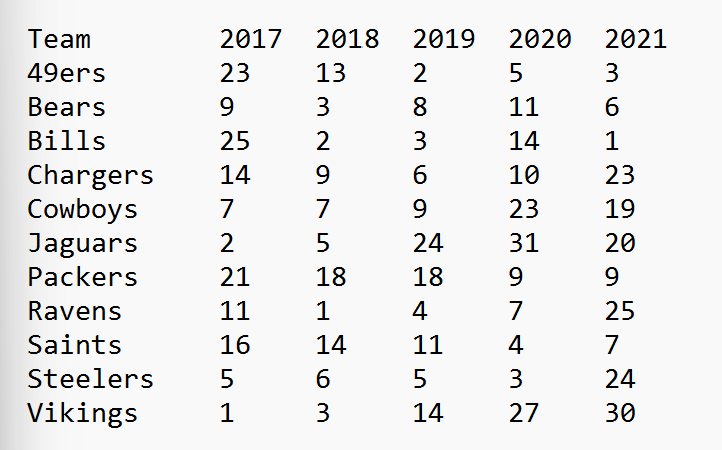
Beginning with the 2017 season, the New Orleans Saints have fielded a defense that’s landed inside the top half of the league every season, a level of consistency only rivaled by the Chicago Bears during that span. Every other top ten defensive unit over the past five seasons has fallen on tough times at least once from 2017-2021. Looking at the production of defenses over the past five seasons offers a few hints as to what the team should expect heading into the 2022 season. Among all teams that fielded a top ten defense over the past five seasons, only 40% were able to sustain the results over consecutive seasons. Digging further into that number, among the teams that were consistently good on defense for two seasons, most sustained that level of play even further. Not counting the Packers and Saints (both teams coming off of back-to-back top ten team defensive performances), there were nine teams with consecutive top ten defensive seasons. Of those, six were able to string three seasons in a row fielding a top ten defense. As for the three teams that didn’t have three consecutive top ten defenses, two (the Jaguars and Vikings) had top ten defenses in 2016, giving both three top ten performances in a row, and the other (the Bills) followed their #14 finish in 2020 with the top defensive performance in the league last season.

With that being said, because the Saints have already shown their worth on defense over the past five seasons (the last two, in particular, being memorable), chances are in their favor to continue showing us who they are in 2022. And while a precipitous drop is always possible, if there is a drop-off in performance, they will likely land in the 16-20 range. Among all teams who have dropped from their top ten standing, the average spot they landed the next season was as the 20th ranked defensive unit. The teams with consecutive top ten seasons fared slightly better when they eventually dropped from that upper tier, with an average finish as the 18th-ranked defense.

So, while we can be somewhat comfortable knowing what the floor and ceiling is for the Saints on defense, we aren’t given the same luxury when predicting their offensive performance. The team’s offensive numbers cratered in the absence of Drew Brees, but it’s not exactly easy to pinpoint one exact area of improvement when the team lacked so many crucial playmakers over the course of the season. When Jameis Winston was healthy, the receiving corps he had at his disposal left much to be desired. Adding Michael Thomas back into the fold, as well as first round draft pick Chris Olave and free agent (and former LSU Tiger) Jarvis Landry, Winston has a trio of targets that easily surmount the talent he was throwing to last season. But the offense’s biggest weapon – Alvin Kamara – is dealing with legal proceeds that will likely result in an NFL suspension at the very least. And as we saw the team’s offense in shambles without Kamara a season ago, any prolonged absence from their star running back will have dire consequences.

The Saints have one of the most talented rosters in the NFL, hands down. The defense is lined with players who rank among the best at their given positions, and the offense has names that have been proven commodities in the past but will need to overcome personal hurdles for the team to reach its potential. But if things do go south, what will happen to all these veterans hungry to win a championship? Will the team try to amass draft capital by selling off its biggest assets? Will they bite the bullet and submit themselves to a painful rebuild? The New Orleans Saints are hoping that the winning culture instilled by Payton and Brees over a decade and a half isn’t the next piece to leave the building.